"That doesn't mean you have to make life in the theatre. As if one could imitate life. What is needed is to rediscover the life of the theatre, in all its freedom."
-- Artaud, "The Evolution of Set Design"
"Cinema: Through poetry, theatre contrasts pictures of the unformulated with the crude visualization of what exists. Besides, from an action viewpoint, one cannot compare a cinema image, however poetic it may be, since it is restricted by the film, with a theatre image which obeys all life's requirements.
"Cruelty: There can be no spectacle without an element of cruelty as the basis of every show. In our present degenerative state, metaphysics must be made to enter the mind through the body."
-- Artaud, "The Theatre of Cruelty--First Manifesto"
Working hypothesis: to be confirmed, disproved, changed, or revised as necessary: that art which calls upon cruelty is--in its social function--diagnostically pessimistic and prescriptively hopeful ... or rather, not hopeful, but active. (Which leads to an uncertain and neutral prognosis, neither fully cynical nor romantic.)

Monday, November 06, 2006

Sunday, November 05, 2006
Cinema Violence
Noël Burch wrote,
"[A]ll really censurable images, whether erotic, repugnant, violent, or truly subversive (as opposed to images that ambarrass a party or a regime, though not society as a whole, and therefore inconvenience a government but do not traumatize its constituents: shots of the slums at Nanterre as opposed to shots of a fraudulent election) are, despite other possible differences, forms of aggression. ... Le Sang des bêtes is certainly not a film for children, but neither is Last Year at Marienbad." (Theory of Film Practice, p. 124)
Films, images retain the power to disrupt our complacency. We just have to keep recognizing how to burrow under our skin the right way. Cruelty can be rationalized, and once it is, its effects are won over as a commodity--one can undergo it willingly (cf. the end of Brian De Palma's brilliant "Be Black Baby" sequence in Hi, Mom!). This is what has happened to the horror film as a genre, very early on even, so that critics who want to argue for horror as 'subversive' must do so on the level of thematic content & interpretation at least as much as on the level of form or simply the pure realization of bloody, terrifying content ... probably more so. (Romero makes thrilling, subtle parables--superb films--but he doesn't assault our eyes and bodies. Fulci? Maaaaaybe.)
Ridley Scott started out as a worthy filmmaker--his first three features are really notable works, though I don't know that he's shot a single good frame since Blade Runner. (No, I haven't bothered to see everything.) I recall the strobe climax of Alien to be interesting precisely because it went out of the ordinary for special effects or mere "atmospherics" to weave in some literal, optical, graphic extremity. (There's also some strobe violence in the first Blade film, right? I have that sitting around somewhere, maybe I should take a look.) These sorts of images, semi-intelligible happenings, get back into the potential of psychic violence that films in the horror vein, grand guignol films, dark oneiric fantasies, can project. (They're what Buñuel thinks about in the moment before he slices the eye in Un Chien andalou, perhaps.) In my imagination, this is what certain recent films I still haven't seen, only heard of, only wish I had a(nother) chance to see, take to the extremes: João César Monteiro's Snow White, the films of Philippe Grandrieux ...
Flicker films remain one of the supreme forms of violent, aggressive cinema. Of course, when I see one of these films, I've come to the theater knowing what I'm in for, looking forward to it. Maybe I myself am even commodifying the experience, certainly I'm well-prepared and whetted for Sharits' neon frames or Kubelka's monstrous-sounding black-and-white Arnulf Rainer for the carefully controlled rushes that these films bring me. Regardless of what it does to me, however, and how I might nullify the violence, rationlize it, and experience it as aesthetic rapture, I see and hear the discomfort these films can still bring to others (which is so rare or tame in horror cinema). And cruelty, the subjection of an audience to discomfort or worse for some purpose, remains mostly a frontier for the whole medium. Is it a frontier worth exploring (and by exploring, destroying)?
There's a specter haunting this discussion, of course:
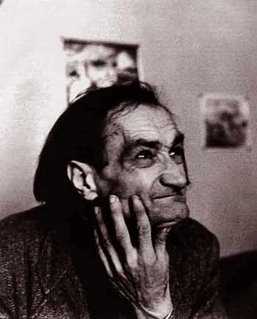
He doesn't look very happy about it, though ...
"[A]ll really censurable images, whether erotic, repugnant, violent, or truly subversive (as opposed to images that ambarrass a party or a regime, though not society as a whole, and therefore inconvenience a government but do not traumatize its constituents: shots of the slums at Nanterre as opposed to shots of a fraudulent election) are, despite other possible differences, forms of aggression. ... Le Sang des bêtes is certainly not a film for children, but neither is Last Year at Marienbad." (Theory of Film Practice, p. 124)
Films, images retain the power to disrupt our complacency. We just have to keep recognizing how to burrow under our skin the right way. Cruelty can be rationalized, and once it is, its effects are won over as a commodity--one can undergo it willingly (cf. the end of Brian De Palma's brilliant "Be Black Baby" sequence in Hi, Mom!). This is what has happened to the horror film as a genre, very early on even, so that critics who want to argue for horror as 'subversive' must do so on the level of thematic content & interpretation at least as much as on the level of form or simply the pure realization of bloody, terrifying content ... probably more so. (Romero makes thrilling, subtle parables--superb films--but he doesn't assault our eyes and bodies. Fulci? Maaaaaybe.)
Ridley Scott started out as a worthy filmmaker--his first three features are really notable works, though I don't know that he's shot a single good frame since Blade Runner. (No, I haven't bothered to see everything.) I recall the strobe climax of Alien to be interesting precisely because it went out of the ordinary for special effects or mere "atmospherics" to weave in some literal, optical, graphic extremity. (There's also some strobe violence in the first Blade film, right? I have that sitting around somewhere, maybe I should take a look.) These sorts of images, semi-intelligible happenings, get back into the potential of psychic violence that films in the horror vein, grand guignol films, dark oneiric fantasies, can project. (They're what Buñuel thinks about in the moment before he slices the eye in Un Chien andalou, perhaps.) In my imagination, this is what certain recent films I still haven't seen, only heard of, only wish I had a(nother) chance to see, take to the extremes: João César Monteiro's Snow White, the films of Philippe Grandrieux ...
Flicker films remain one of the supreme forms of violent, aggressive cinema. Of course, when I see one of these films, I've come to the theater knowing what I'm in for, looking forward to it. Maybe I myself am even commodifying the experience, certainly I'm well-prepared and whetted for Sharits' neon frames or Kubelka's monstrous-sounding black-and-white Arnulf Rainer for the carefully controlled rushes that these films bring me. Regardless of what it does to me, however, and how I might nullify the violence, rationlize it, and experience it as aesthetic rapture, I see and hear the discomfort these films can still bring to others (which is so rare or tame in horror cinema). And cruelty, the subjection of an audience to discomfort or worse for some purpose, remains mostly a frontier for the whole medium. Is it a frontier worth exploring (and by exploring, destroying)?
There's a specter haunting this discussion, of course:

He doesn't look very happy about it, though ...
Saturday, November 04, 2006
Quotes of the Day (and Coming Attractions)
"For writers, banishment confirms the fact that literature is not benign. Most of the Chilean, Argentine, and Uruguayan writers forced into exile in recent years are paying the consequences of using words freely. As everyone knows, the dictatorships of the South erected a machinery of silence. They hope to hide reality, to erase memory, to empty consciences. From the vantage point of this plan for collective castration, the dictatorships are right to send books and newspapers that smell of gunpowder to the bonfires, and to condemn their authors to exile, prison, or the grave. Some literature is incompatible with the military's pedagogy of amnesia and lies."
--Eduardo Galeano, section 2, "Exile, Somewhere Between Nostalgia and Creativity" (trans. Mark Fried)
"For us who are determined to break the back of colonialism, our historic mission is to authorize every revolt, every desperate act, and every attack aborted or drowned in blood."
--Frantz Fanon, "On National Culture" (p. 146 of The Wretched of the Earth, trans. Richard Philcox)
These are older words, above, but their urgency is no less deeply felt because of it. A viewing list, ten films whose role is to help in a struggle great or small, on some of which I promise to write in the next few months:
Arsenal (Aleksandr Dovzhenko, 1926)
The Battle of Algiers (Gillo Pontecorvo, 1966)
Land and Freedom (Ken Loach, 1995)
Strike! (Sergei Eisenstein, 1924)
Sweet Sweetback's Baadasssss Song (Melvin Van Peebles, 1971)
Winstanley (Kevin Brownlow & Andrew Mollo, 1975)
Zero for Conduct (Jean Vigo, 1933)
La Commune (Paris 1871) (Peter Watkins, 2000) *
Salt of the Earth (Herbert J. Biberman, 1954) *
Flame (Ingrid Sinclair, 1996) *
* These last three I haven't seen (I know, I know), but are high on my to-see list ...
Sunday, October 29, 2006
Studs Lonigan
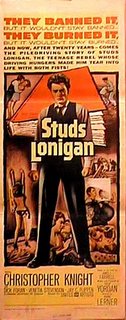 What was I saying about only one Lerner film under my belt? Well, now it's two--this and Murder by Contract ('58), both solid films (Contract's probably better) that make me think, in terms of both tone and subject matter, of the sort of films Scorsese might started out with had he been ten years older. In fact Studs Lonigan, a once-controversial screen adaptation project for Lerner and writer-producer Philip Yordan, seems like a quite viable inspiration for Scorsese's GoodFellas and Casino, possibly also Mean Streets (but it's been too long since I've seen that one). The difference is that in Scorsese's films, characters have the feeling (the thrill) of agency--they get to be movers-and-shakers, and when things come crashing down (or when the thrill simply decomposes into the mundane), it hurts. In Studs Lonigan, our hero (played by Christopher Knight) never even really gets to grasp that sense of being in charge of his own destiny ... he just spends the duration waiting for it. Flirtations with the underworld never go beyond a few fizzled get-rich-quick schemes or mobster handshakes; alcoholism is the greatest vice Studs can get himself into. In a way this makes it all the more pathetic. And if absolution never comes, the film also remains, because of it, more incisive about the vagaries and illusions of middle-class existence than Scorsese's ever are.
The camerawork (a lot of strange angles from below) seems to be a bit of a marriage of early 1930s Robinson or Cagney vehicles (the film itself takes place during the 1920s) with Cassavetes and Beat energy of the time, the sort of flexed-muscle pulsing improv realism that marked the emergence of Something New on mainstream American screens at the time. (Sorry, is that "x-crossed-with-y" description too The Player-ish?) I can't say that, on one viewing, the film had a particularly clear and meaningful aesthetic organization, but it's in the half-exposed formal blueprints that one may find the most interesting strategy anyway.
At one point, deep in the film, Studs and one of his friends are playing pool. The friend says, "I met a pig last night. How's your love life?" Studs replies, "Catherine and I ... we drink a lot of coffee." At several earlier points in the film, scenes that open up like this in the pool hall may last for several minutes, but right after the coffee line we get a jarring cut to the beach. There are several such jarring cuts which seem to deliberately "rough up" the surface of the smooth classical Hollywood narrative: that is, the film isn't avant-garde or experimental, it isn't a profoundly subversive take on the H'wood narrative--it simply wants to render it less invisible, less taken for granted.
Any Lerner fans out there? What else is worth catching?
Velázquez of the Day
A painting from one of the 17th century's great masters.

The Needlewoman (1640). A simple portrait in whose details we can find a template for the cosmos. Faint brushstrokes establish the play of movement in hands & shoulders. Compare.
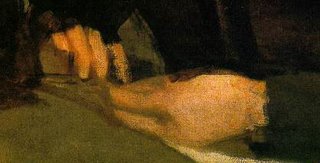

The highlighted bust: a robust physical reminder in the middle of drab clothing and dutiful work. Our bodies are not ephemeral; and as Wilheilm Reich and Robert Bresson might have agreed after a long conversation (or a short one), we don't have bodies, we are our bodies. Appearance is only the first step towards recognition of immanence. Compare.

Intent eyes, downcast--concentrated upon labor, and mysterious and complete in themselves to the viewer. Here is evidence of a psyche that is opaque and inscrutable to us. Compare.


The Needlewoman (1640). A simple portrait in whose details we can find a template for the cosmos. Faint brushstrokes establish the play of movement in hands & shoulders. Compare.


The highlighted bust: a robust physical reminder in the middle of drab clothing and dutiful work. Our bodies are not ephemeral; and as Wilheilm Reich and Robert Bresson might have agreed after a long conversation (or a short one), we don't have bodies, we are our bodies. Appearance is only the first step towards recognition of immanence. Compare.


Intent eyes, downcast--concentrated upon labor, and mysterious and complete in themselves to the viewer. Here is evidence of a psyche that is opaque and inscrutable to us. Compare.


A Canon Tally
"If one took all the masters and models through whom the Filmkritik directors explored their own work, and if one looked at selected works in retrospect next to each other, one could very quickly see the points of aesthetic convergence, and through these roughly sketch out the Filmkritik-style. The next step would be to describe the differences between the individual filmmakers. The great unifying figure, the director whom all honour to the same degree, is Jean Marie-Straub. Among the classical masters, they love Rossellini, Renoir, and Ford; they discover Grémillon and Ophüls again (for themselves); they define their work ethos via the pragmatism of Hawks, Tourneur and Sirk among the acknowledged directors, and in their writings seek proximity to Daves, Lerner, Fejos, and Hurwitz. Among their contemporaries they surround themselves with Pialat, van der Keuken, and Nestler."
-- Olaf Möller.
The trio of "classical masters" and those three 'pragmatists' of the American cinema I have covered fair enough. But Straub & Huillet, as mentioned here recently, I've still seen too little of. Off the top of my head: Grémillon, only one film; Ophüls, I'm still missing a couple of big ones (like Letter to an Unknown Woman); Daves, two or three films; Lerner, only one film; Fejos, no films; Hurwitz, no films; Pialat, six or seven; JVDK, nothing; Nestler, nothing.
Damn, I have work to do!
I plan on getting more regular, and extensive, posts up soon, but I still have problems with my DVD player--I think this is a software problem, as at least the brand new DVD-burner works just fine. All I've been waiting forever to do is take screen caps off of my computer ...
Sunday, October 22, 2006
Modesty, Penguins, Thought Bubbles
Speaking of Losey, I haven't watched his Modesty Blaise (yet). But I did come across some great pulpish covers to the series that spawned the movie (try here and here). I love old, brittle paperbacks and comics--and I really love the covers, with with this range of (broadly) mid-20th century design. (For example, the sorts of things that Germano Facetti did at Penguin in the 1960s, the middle two covers being examples below.) The superb blogger Owen Hatherley sometimes writes about this sort of design. The basic illustrative invention on display in any number of 1970s-80s newsprint comic books, and the free play of panels across pages that could sometimes mark really interesting ones, attract me still, even though my days as a "comic book fan" are more than a decade past. (It wasn't long after I gave up or "grew out of" comics that I discovered films.) The fourth image below is from a '70s comic called Iron Wolf (which I've never read or even heard of, but I somehow stumbled upon that blog entry and it sounded fascinating), and the last image is of course the famous Pogo one ...


Saturday, October 21, 2006
Losey's Klein

Michel Ciment: "For the grand rafle you used a lot of Jewish extras."
Joseph Losey: "Not only that--but many people of the crew had a direct experience of the period. Trauner for instance was a Hungarian Jew who had to work in a clandestine fashion when he was set-designing for Carné. The extraordinary casting director, Margot Chapellier, lost many of her family in the camps. The head of the laboratory at LTC, Claude Lyon, lost his mother this way too. We went to Jewish organizations for the final round-up of the Jews at the vel d'hiv. From them I had several thousand extras. On the first day of shooting at the stadium, quite a number of the older people just had to give up because they found it so close to what they had experienced that they couldn't stand it emotionally. They came to me and said 'We don't want any money but we're turning in our yellow stars because we simply can't stand and watch this for three days.'"
(Michel Ciment, Conversations with Losey, London/NY: Methuen. 1985. p.346-7.)
* * *
With a DVD viewing of Mr. Klein last night, I think I'm finally starting to get Joseph Losey. I've basically liked the handful of films I've seen by him but I never could find a way in, totally past that old cliché of 'appreciation more than affection.' Now things are starting to make more sense. Thematically speaking, Losey seems to gravitate to protagonists who slowly, desperately come to realize (if not completely comprehend) the structure and parameters of the prison-narrative they've been built into. In Mr. Klein it's about a certain obsession with one's own (very civilized) complicity in utter social & political savagery.
At several points in the film, Alain Delon appears in a crowd, long shot, and our eyes are drawn to him (still) while the people around him are mainly in motion. The ocular attraction of the individual that we hold for Delon in this instances is grafted onto the more fleeting instances where Delon's Robert Klein spies the other Robert Klein, who (unwittingly?) flees our protagonist's grasp as easily as horror movie villains stalk victims by merely walking--it's irrational, but the film insists on our acceptance of it.
I'd have to look at the film again, but I got the feeling that the colors in Delon's wardrobe were slowly leeched out during the course of the film--when we first see him he's in a rich, mustard- or rust-colored coat. By the end of the film he's wearing a pale trench coat, as though this experience is draining him metaphorically as a character, literally as visual screen presence. (Very possibly my perception is off, however.)
After the movie was over I saw that Jesus Franco's Vampyros Lesbos was coming on some channel last night (Sundance, I think), and so I decided I'd watch a little bit of it just to see what it's like (thus far I'm not sold on Franco). Over the course of the last night, the anti-semitic drag act in Mr. Klein has blended a bit in my memory with the the wordless lesbian performance we see in the beginning of Vampyros ...
... Dan Callahan, writing a Senses of Cinema Great Directors profile on Losey, thinks little of Mr. Klein: "though acclaimed by some, [it] is a laborious tale of the French Occupation told at a funereal pace. The customary nervousness of his camera had turned clumsy and awkward by this point." Do any EL readers agree!?
Andy Rector on The Lawless.
* * *
MC: "If you had not had your experience of McCarthy in America, you might not have been able to recreate so well this atmosphere of indifference and fear."
JL: "Certainly, because nobody was prepared to take a stand and say 'No.' Because if they did, then they were immediately blacklisted. The ultimate of that kind of attitude is what is happening now, torture as policy. Not torture to get information, because the police already have the information. Torture them long beyond the point where there would be any information that they could possibly give if they had it. The aim is to make everybody on the street so frightened that they won't even remotely engage in any kind of activity."
(p. 348)
* * *
MC: "Klein II must belong to the resistance. There's no other way of explaining his strategy."
JL: "Of course. That's why the girl works in a munitions factory. I wanted to show that he was a Rothschild type of Jew, who had musical gatherings and female companions, but who was at the same time committed. I'm thinking of Jean Lurçat, for example,a very cultured man, a remarkable painter, who became a leader in the Resistance. For if you are sensitive and enlightened, you make certain decisions in certain circumstances, you can't be an average bourgeois who eats at La Coupole. As Brecht said in Galileo, 'You can't pretend you haven't seen what you have seen.'"
(p. 354)
Wednesday, October 18, 2006
VHS Eulogy
An inferior technology nobody wants; people have not even bothered to say goodbye to VHS, and why should they? Except in the sense that a standard video dub appears--at this point--to be more resilient and lasting than a standard consumer DVD-R, there are no advantages offered by VHS (as a medium) to the average person, and hence almost no more champions for its cause.
But it has a history, and I and many other cinephiles helped forge our cinephilia from this bastard thing, home viewing on television sets. The first good video store I knew was a local branch of Potomac Video, a local DC/Virginia/Maryland chain with pretty decent selection. There was one a five minute drive from my house, and I remember that when I was 16 I went to see a movie with my Dad at the second-run theater, and on the way back we stopped by Potomac, where we signed up for membership, and I checked out two videotapes--The Texas Chainsaw Massacre and (this was the really important one) Days of Heaven. Rentals were $2.50 for a week, and through my junior and senior years of high school I made a near regular habit of two rentals a week. (The other sources of film-viewing at this time were commercial theaters and the occasional foray into DC's small but competent repertory scene, as well as my growing collection of VHS tapes recorded off of television.) The "video store" had, until this time, meant Blockbuster and its ilk--now I had films to watch that I'd only been reading about for a few years: Godard, Tarkovsky, Tsui Hark. I remember renting and watching Playtime with my friend Sahar down in my basement-room one evening, and we laughed hysterically and we're moved by this profound comedy, and it was not long after that that I started calling Playtime my favorite film. I didn't even get to see it on celluloid until 4-5 years later. I can vouch--Playtime, as much as it should be seen on the big screen, really is a durable work of art.
When I was a senior in college, someone else I knew, Maureen, left my roommates & I a few videotapes that she no longer wanted--she was also from the DC area, and used to work at another branch of Potomac Video, and had purchased these trashy tapes for a buck apiece when her store was selling them off. I still have the tapes and have watched them--Enzo G. Castellari's 1990: Bronx Warriors and Steve Carver's Angie Dickinson vehicle Big Bad Mama.
Nothing can replace--and nothing should supplant--the experience of the cinema; but VHS and the presence of movies on the tube did offer a new set of possibilities for the cinema to allow people to relate with one another, directly or not, and this way is simply continued (possibly perfected?) by DVDs. But the idea of buying a packaged object with which is something that is not "of the future," and when DVD dies out too, it will only be as a facet of the blip of home viewing tradition initiated by videotape and laserdisc. Tomorrow we pay for a streaming video, or an account with storage space on a server somewhere, or something else ...
I can't be the only cinephile out there who's interested in rescuing rejects from these videotape purges, these trash bins, $1-5 for sometimes great and sometimes rare (unavailable on DVD!) titles. I can't be the only cinephile for whom VHS still offers some attraction, because sometimes the home viewing experience for me is not about approximating the best picture and sound possible, with proper aspect ratio even!--it may also be about reviving phantoms of what you already knew and saw, what you long only hoped to see, compromises intact, and simply keeping alive a trickle of an imperfect practice that helped open your eyes when you were an adolescent.
Friday, October 13, 2006
Quote of the Day (IMDB Special)
The Comment:
"I am aware that this has won awards. There is something to this, that this film, like Titanic, scratches some Emo-self pitying itch that a better film never could without letting us be aware of it and sickened at ourselves.
"For my part, I say everything you can learn about absolute control of shots and minimalistic pedestrian acting, you should just see the later film Wall Street, it's very controlled, and it's actually about money, instead of about idiocy." (Final paragraphs, here.)
The Film:
L'Argent. Not joking.
Wednesday, October 11, 2006
Death (but not of cinema)
I'm not particularly well-acquainted with the films of Straub and Huillet, just a small handful, but the news of Danièle Huillet's recent death comes as a painful blow for those who would hope to make a better world (and make or advocate art that can help in that struggle). I can't say anything meaningful about Huillet's passing right now--and anyway Andy has already said a few words very well, so I can only endorse what he wrote, from my vantage point, which is less informed about the Straubs than his.
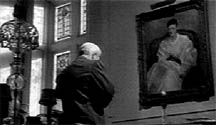
Who in cinema has left us these last few years (in this PB, Post-Bresson, age)? Andre De Toth, Jean Rouch, Walerian Borowczyk, Stan Brakhage, Maurice Pialat, to name a few that hit hard for me. Giants who aren't walking the earth any longer. But I suppose the cinema would not be the cinema without the threat of death and loss looming all around it--inside and outside of it. That's something John Ford might have understood better than anyone, and the Straubs, great admirers of Ford, surely had a enviable grasp of this basic truth. I find something oddly compelling in the fact that, at this moment, this by-all-reports fundamentally symbiotic filmmaking couple is now straddling the divide between the living (Straub) and the dead (Huillet). Jean-Marie Straub will never read this, but, regardless, I offer these images of Fordian communion ...



Who in cinema has left us these last few years (in this PB, Post-Bresson, age)? Andre De Toth, Jean Rouch, Walerian Borowczyk, Stan Brakhage, Maurice Pialat, to name a few that hit hard for me. Giants who aren't walking the earth any longer. But I suppose the cinema would not be the cinema without the threat of death and loss looming all around it--inside and outside of it. That's something John Ford might have understood better than anyone, and the Straubs, great admirers of Ford, surely had a enviable grasp of this basic truth. I find something oddly compelling in the fact that, at this moment, this by-all-reports fundamentally symbiotic filmmaking couple is now straddling the divide between the living (Straub) and the dead (Huillet). Jean-Marie Straub will never read this, but, regardless, I offer these images of Fordian communion ...


Sunday, October 01, 2006
Book Meme
I don't normally do these things, but (a) Matt tagged me and (b) this one's harmless. You may have seen this meme making its rounds all over already. Books are my great weakness as far as spending money & taking up apartment space--my ideal home would basically be a library with a bed & a kitchen. I don't own thousands of books, but I have enough to groan at the thought of my next move (whenever that will be).
1. One book that changed your life?
When I was a junior in high school I read Faulkner's As I Lay Dying, which got the ball rolling (at first only slowly) to undo the damage of the previous 3-4 years of intellectual stagnation brought on by the middle of adolescence.
2. One book that you have read more than once?
The Communist Manifesto. (Since Matt mentioned a Barthes book, I could also choose my own: Mythologies.) I'm not much of a "re-reader" in the sense that I read a book from cover to cover multiple times. I have done that, of course, but because there are so many titles I feel compelled to read, I'm more likely to revisit passages of an old favorite rather than go through the whole thing again. I tend to tell myself I'll go through the whole thing again a little bit later in life. (I do the same with films.)
3. One book you would want on a desert island?
This question is impossible! Let me sketch a few scenarios. Am I deserted on the island with friends or acquaintances--i.e., we all survived the same shipwreck and are together on the beach? Then, if not a survival manual (that's really the #1 answer in all cases, but subverts the spirit of the question), I'd want something in which I could indulge contemplation and solitude amidst these people ... maybe I could finally read The Tale of Genji. Am I deserted all alone but have a big box of supplies, some booze, and reason to believe that I'll be picked up in a few months? Then I'd want a big, vaguely "literary" potboiler of a novel to pass the days and read several times--a really rich, compulsive page-turner, which could be The Count of Monte Cristo (if I'm in a 19th-century novel mood) or maybe something by China Miéville (if I want something weirder). If it's just me on the island, probably facing a gradual death, then I think I may want a book where I can gain comfort from my solitude--on the island and in the cosmos--say, W.G. Sebald's The Rings of Saturn, or a book of Paul Bowles' short stories.
4. One book that made you cry?
Elective Affinities. I think it's even sadder than Young Werther, at least the translations that I've read. It's one of my very favorite books.
5. One book that made you laugh?
I never finished it, I took it on a train ride from New York to my parents' house years ago, and only got halfway before accidentally leaving it behind ... but I remember thinking that Booth Tarkington's Seventeen was one of the funniest things I've ever read.
6. One book you wish you'd written?
How about Ruiz's Poetics of Cinema?
7. One book you wish had never been written?
Nobody seems to like this question, and for good reason. Can I make the socially responsible choice and say Mein Kampf (thereby suggesting that I wish to use my hypothetical powers to avert Nazism and the Holocaust)? If I wanted to be snide I could point out one of those screenwriting or "how to break into Hollywood filmmaking" manuals, but I don't know the titles of any ...
8. One book you are reading currently?
I'm in the middle of several, but the that I started most recently was Parker Tyler's Underground Film: A Critical History.
9. One book you have been meaning to read?
There are a million--but the most imposing/inviting one that I actually have on my bookshelves is the Donald M. Frame translation of Gargantua and Pantagruel. I'll get to it sooner or later.
10. Pass it on.
Whoever might want to do this meme should just do it, and link to it in the comments so we can read. I don't want to pick just three people.
Friday, September 29, 2006
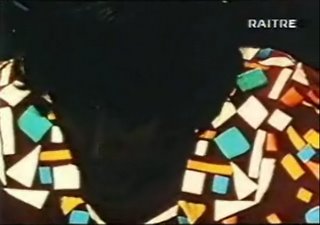
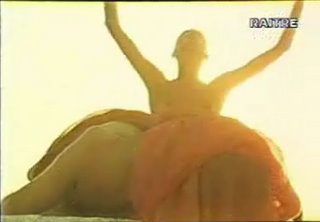
Stills from Salomé
Carmelo Bene, Italy, 1972. Like a neon lovechild between certain films by Fellini and Jarman. At this point, anyway, stills are the best thing I can offer about the film.





Wednesday, September 27, 2006
Abel Ferrara
So, after leaving a screening of Old Joy, my buddy Ryan and I ran into Ferrara on Houston Street last night. Unlike last time I passed by him on the street, I mustered the courage to accost him. I called his name as we approached each other, he fidgeted with his cell phone (which he was talking on), gave me his left (free) hand to shake, and muttered something to the effect of 'hold on' into the phone. I said I was a big fan, and he asked if we were filmmakers. (Maybe if we said yes he would have invited us to some crazy party?) I said, "No, I'm not a filmmaker, but I'm an avid film-watcher," at which point he busted into a quick chorus of "Girl Watcher." He assured us that Mary was coming to theaters sooner or later and that for his next project they'd be going to Italy to shoot. He shook our hands and we parted ways. Hot.
Monday, September 25, 2006
Genre, et cetera
The other day I watched René Vienet's amazing example of Situationist détournement, Les Filles de Kamaré (1974), which takes two 1970s Japanese cult films (by Teruo Ishii and Norifumi Suzuki), mashes them up with a little bit of hardcore footage shot by Vienet himself, and subtitles the films with lines like "Your signifier is equal to your signified." Eventually the dogmatic capitalists are overrun by oppressed schoolgirls who long for liberation! The film brings to the surface any number of thoughts we might have when we watch a genre film or a cult film and think of them as "subversive." Andrew Grossman writes,
"Undercomplexity is more challenging than overcomplexity. One can always play with symbols and close-read a complex text into comfortable ideology. But undercomplexity is the absence of a text to move against — it is a mirror in which one flounders for semiotics where none exist."
This isn't an anti-intellectual jab: it's couched within a very long (and not easily summarized) piece about the nature of our engagement with genericism and meaning, our very investment in cinema and its roles in the world at large. (The title is: "What We Talk About When We Talk About Ho Meng-hua.") Vienet's film (I haven't yet seen Can Dialectics Break Bricks?) shoehorns a 'reading' onto a generic undercomplexity--unconcerned with what the film "really" means or "subversively" suggests (by some way readable through theory or form). Vienet simply recognizes a structural isomorphism with his ideological product and grafts himself onto the pre-existing product, making it new in the process.
I keep thinking of Sympathy for the Underdog (Kinji Fukasaku, 1971), a terrific film, and very beautiful.
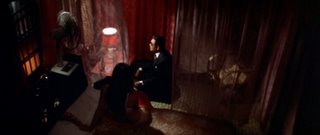
It's beautiful largely because its deep, saturated colors, the rhythm of the lines in its frames, are sad and tentative. The (anti-)hero is regurgitated back into a life of crime despite all his best wishes--like innumerable gangster films!--and Fukasaku turns this conceit (cliché?) into poetry. It's beautiful because it can't last: it doesn't make thuggish capitalist-criminalism attractive so much as it dramatizes & poeticizes the generic inevitability of these gangsters' demise. (Like the oh-so-Japanese proverbial falling rose petals, etc.)
One may love the bottom rungs of generic art, one may appreciate them, learn their ins and outs, love the mediocrities as much as the stand-outs and all-stars. A proposition I'm considering: that we realize a genre film truly flexes its muscles, goes to a proper level of complexity or pungency or robustness, when we couldn't bear to have Vienet's treatment repeated to it.
An obstacle: how then do we ever know we're not simply being "seduced," so to speak, by generic charms? (After all, the Situationist-style treatment works best when it agitates and unsettles the most.) The answer for now is: vigilance, constant vigilance, and a lot of open discussion with cinephilic comrades ...
"Undercomplexity is more challenging than overcomplexity. One can always play with symbols and close-read a complex text into comfortable ideology. But undercomplexity is the absence of a text to move against — it is a mirror in which one flounders for semiotics where none exist."
This isn't an anti-intellectual jab: it's couched within a very long (and not easily summarized) piece about the nature of our engagement with genericism and meaning, our very investment in cinema and its roles in the world at large. (The title is: "What We Talk About When We Talk About Ho Meng-hua.") Vienet's film (I haven't yet seen Can Dialectics Break Bricks?) shoehorns a 'reading' onto a generic undercomplexity--unconcerned with what the film "really" means or "subversively" suggests (by some way readable through theory or form). Vienet simply recognizes a structural isomorphism with his ideological product and grafts himself onto the pre-existing product, making it new in the process.
I keep thinking of Sympathy for the Underdog (Kinji Fukasaku, 1971), a terrific film, and very beautiful.

It's beautiful largely because its deep, saturated colors, the rhythm of the lines in its frames, are sad and tentative. The (anti-)hero is regurgitated back into a life of crime despite all his best wishes--like innumerable gangster films!--and Fukasaku turns this conceit (cliché?) into poetry. It's beautiful because it can't last: it doesn't make thuggish capitalist-criminalism attractive so much as it dramatizes & poeticizes the generic inevitability of these gangsters' demise. (Like the oh-so-Japanese proverbial falling rose petals, etc.)
One may love the bottom rungs of generic art, one may appreciate them, learn their ins and outs, love the mediocrities as much as the stand-outs and all-stars. A proposition I'm considering: that we realize a genre film truly flexes its muscles, goes to a proper level of complexity or pungency or robustness, when we couldn't bear to have Vienet's treatment repeated to it.
An obstacle: how then do we ever know we're not simply being "seduced," so to speak, by generic charms? (After all, the Situationist-style treatment works best when it agitates and unsettles the most.) The answer for now is: vigilance, constant vigilance, and a lot of open discussion with cinephilic comrades ...
Thursday, September 21, 2006
The Black Dahlia
It's almost underwhelming, now--De Palma-philes were prepared for an event, and The Black Dahlia, to my mind anyway, doesn't feel like one. It's clearly the most "commercial-minded" of De Palma's films since Mission: Imposible. That film has slowly revealed to us some hidden beauties over the years--we'll have to wait and see if The Black Dahlia does likewise.
The trouble (trouble?) is that it's actually a good genre film if you ask me. If Joe No-name were the credited director, people would (or, hypothetically, should) be saying it is a nice yarn, for all the limited positivity of such a statement. I don't understand the negative reviews, or rather, I can't put myself in the mindset of their magnitude. The movie is convoluted, sure, but it's hardly impossible to follow. Its overall shape is nice and rounded--The Black Dahlia affects a lot of different tones (e.g., Fiona Shaw's performance set up next to a sultry Hilary Swank!?) and I think it accomplished this risky business competently.
Specialists of the genre can feel free to challenge me on this, but--it would seem to me that the neo-noirs of the 1970s (the first times that people decided they'd make films that were specifically noirs and not "crime movies" or the like) gave way to the neo-neo-noirs of roughly the last decade, where historical signification is highly important and must be coded as stylishness above style-neutrality at all costs (Devil in a Blue Dress; The Funeral; L.A. Confidential) ... De Palma is a perfect "hired hand" for this sort of thing! This form of 'history' being merely the constellation of the properly satisfying (not always correct) semiotic codes, a way of presencing our past (so to speak), this is precisely what De Palma does before he even worries about the meatier questions that consume him as an artist. And the workings which come from the genre and (I can only assume) the Ellroy novel, wherein Josh Harnett's character has to reconfigure events and images he's already seen but (he realizes) has drastically misunderstood and wrongly evaluated ... that's a straight-up De Palma trope. Of course, from the sampling I've done of negative reviewing, it seems that some people are disappointed that De Palma didn't do more of "his" techniques, no bold and baroque flourishes (which I suppose were wanted to merely embellish and intensify the kewl genre trappings?). I empathize with this brand of disappointment--but I wonder why there were so few such BDP defenders with Mission to Mars and Femme Fatale, generic failures that were actually quite impressive films full of De Palma goodness?
So this is where I feel bad wishing that there were something more from The Black Dahlia. On its modest terms, it's perfectly fine--ten or twenty years from now, maybe the film won't appear to be anything too special. (FYI, Keith Uhlich makes a worthy early case that it is special.) But neither will it--would it--appear a blight on De Palma's or any comparable filmmaker's filmography. I'm not saying the film is devoid of interest for fans, that it is 100% a "job of work" and nothing more. But my impression upon first viewing is that it's accomplished studio filmmaking made by a man exceptionally well-suited for this project, with only minor interest in terms of the De Palma vision, worldview, or stylistic development.
Tuesday, September 19, 2006
Sad Faces

Kikunosuke (Shôtarô Hanayagi) and Otoku (Kakuko Mori) in Mizoguchi's The Story of the Last Chrysanthemums.
Sunday, September 17, 2006
Oharu

The scene in Life of Oharu (1952) that begins with the above image: the scene where Oharu sees her son for the first time since she gave birth to him, the second of three times in her life. Oharu plays music and begs (like a woman she met earlier in the film). The camera moves up to reveal, in the background deep to Oharu's left, a procession from palace gates. The heroine puts down her instrument, scurries over to catch a glimpse as the palanquin is lowered. Her biological son, the future Lord Matsudaira, is given a snack. The procession moves on, leaving Oharu behind. She curls up on the mat where she played her sad song before, but plays nothing now. She puts her hands into her sleeves, and shivers. One of the most heartwrenching moments in the cinema; also one of the most intelligent uses of space. As he does so often, Mizoguchi "opens up" the frame to reveal a deeper truth than is originally presented in the first image of a sequence--the movement of the camera, the range and authority of its vision, make clear relations, causes, injustices, appeals that are otherwise submerged.
Saturday, September 16, 2006
The Hired Hand (1971)
So Easy Rider (not really one of my favorite films) gave free reign not only to Dennis Hopper to make a great film of 1971, but also Peter Fonda! The Hired Hand is less impressive than The Last Movie to my eyes, but overall it's a very beautiful film. It's lyrical but not idly so (its lyricism is part of a system). I feel like Dennis Hopper may have been something like the Tasmanian Devil on the set of The Last Movie, perhaps not a control freak but a tyrant of sorts. Fonda seems to have trusted the talents of his collaborators (Zsigmond, editor Mazzola, the cast), one could conceivably pay attention to a specific aspect of the film at the expense of the others (cinematography, musical score) and say something complimentary about it (whereas it's difficult to do this with Last Movie) ... but the film still retains the impression of unity and coherence, a singular dedication to this story that is also a reflection on its own archetypes (despite the fact that this is a laconic work, what a forthright & revealing handful of conversations the characters have about their own relationships!). Then there is an "honest day's work"--it's always refreshing to see work portrayed in a movie, too often it's glossed over as a matter of narrative inconvenience.
Tuesday, September 12, 2006
Celebrity, Television, Civility
Film producer and publisher Gérard Lebovici (who does not have an IMDB entry) was murdered on March 5, 1984. He was a friend of Guy Debord's, who wrote a slim book, Considerations on the Assassination of Gérard Lebovici (finally published in English in 2001) attacking the media's treatment of Lebovici and himself and their friendship in light of the assassination (which is still unsolved). At a certain point there is a very telling paragraph that I will quote at length:
"This press campaign had barely been set in motion before numerous journalists attempted to get an interview with me, ringing at my door or even telephoning me directly, despite the fact that my telephone numbers are always unlisted. They were all turned away by my friends. Dozens of photographers, in groups or individuals, and even some cameramen, stationed themselves in front of my windows for several weeks, waiting to get a picture of me on the sly. It is comforting to note that all the time spent by these incompetents came to nothing, with only one exception--after months of trying, someone managed to get a blurry, and not very interesting silhouette taken through a telephoto lens by inflitrating the house next door. The photograph, coupled with some hateful commentary, was then published by Paris-Match. The journalists of today are so accustomed to the public's submission--even their complete delight--when faced with the press' voracious need for information (of which journalists are apparently the great priests, but in fact the hired help) that I truly believe that much of the press deems guilty the person who would claim to not have to explain himself before their authority. But for me, I have always found it a crime to speak with journalists or to appear on television, in other words, to collaborate in the slightest way with the great enterprise of the falsification of reality that is lead by the mass media. It is quite normal for me to think so, and consquently to act this way, since I published the theory on this a long time ago. The press believes that all those who have access to this sort of the celebrity of the moment want it, and indeed want it as often as possible. But I have nothing to sell. Discretion is not viewed well in these times. An article in the March 23 Le Nouvel Observateur provides a revealing demonstration of this: " 'In my long career, I have never seen as strange and mysterious an affair as this one,' said an important police commander.... And he concluded, in a pensive tone: 'What do you expect--by living in secrecy, one dies in darkness.' " In this statement emerges a new sociological law which actually makes one pensive. This "important police commander" has just supplied a brilliant contribution to the theory of the spectacle. He introduces the definition of a new criminal offense. He who does not, of his own free will, make himself as visible as possible in the spectacle, lives in fact in secrecy, since all current communication in society passes through this mediation. He who lives in secrecy is a clandestine person. A clandestine person will be more and more likely to be considered a terrorist. In any case, a clandestine person is not able to frequent honorable people; and one would not therefore be terribly astonished if such person met a violent and mysterious death."
To what extent does one participate in all the Big Media of the day? More and more I feel the urge to turn and 'say no' to as much of it as possible ... but is this just tantamount to a head-in-the-sand approach? Maybe piracy is an answer. I don't know. I broke down and ordered cable in June so that I could watch World Cup games. My girlfriend and I have kept cable, even though I personally only watch it for the occasional soccer match, Food Network program, or--my guilty/unguilty pleasure--Project Runway. I could try to satisfy myself with this: "Oh, I only watch a few shows..." Because really no matter what I think I mean is that I'm still saying, "I pay x amount of dollars each month to have this cabled into my apartment, use it sparingly and so am doubtless paying too much by any standard, but justify my occasional tuning-in as an obedient set of advertisement-bombarded eyes through this very extravagance of barely using something I still pay x amount for." All I'm getting from television is entertainment, and I can get that any number of places, without purchasing the rights to see it month-to-month, and without selling myself as a statistical blip for ratings & advertisers.
One of my favorite blogs is Le Colonel Chabert. Back when le Colonel was known as Alphonse van Worden, she wrote on the work of Patrick O'Brian (of Master and Commander fame):
"The great poet of civility of the 20th century, Patrick O'Brian, proposed a code of civility whose central posture is not a soft voice, peaceable 'diplomatic' manner, or feigned flexibility of opinion, but discretion. The civil being controls his curiosity, permits the other his privacy and anonymity. Asking questions, interrogation, is in the novels of O'Brian a more serious transgression against civility than flinging an unblunted insult or even dealing a physical blow. The forced (or betrayed) confidence is the most heinous violation. 'Question and answer is not a civilized form of conversation,' declares the wandering Catalan-Irish-Catholic (crypto-Jew) Dr. Stephen Maturin, United Irishman, physician, natural scientist, and British intelligence agent."
...
"Amazon knows me better than I quite like. 'Alphonse, this is what we recommend.' Amazingly intuitive usually. I'll take it, and that, and that too. Once in a while something repellant comes up for my consideration, and I can't help but feel Amazon means to insult me. They immediately sense my discomfort. Indeed they read my mind, offering the question, minus two words, that has just entered my head: 'why was I recommended this?' Yes why? And the response sounds irksomely reasonable - because you bought this, that, and that...well so I did. Perhaps they have a point."
"It is impossible to protect one's anonymity with Amazon. Futilely protest your individuality, quirkiness, irreducibility to type."
"Perfect Intimacy: the relationship of the advertiser to the consumer. Seduction and control of which Cholderos de Laclos could not have dreamt, the permanent expulsion of eros from human experience. The ideal romance for capitalism: What Women Want, a film by Mel Gibson, a market researcher's fantasy of free infallible data collection - he hears women's thoughts - a film constructed around a long Nike advertisement which takes the place in the narrative usually reserved for the love scene or ecstasy of shared peril."
Yes.
The battle against 'bad culture' isn't a matter of high and low (well, maybe for some people it still seems to be) ... it's rather a question of protecting our humanity, our privacy, our civility. If the world changes too drastically, if certain things we hold dear are to be swept aside as happens through history's course, then I would at least want to bend some of these inevitable changes (if inevitable they be) to my own terms, at my own pace. But Guy Debord did this, and is always mentioned with knowing smirks for it. Attacks on Debord tend to be groundless, toothless insults and simplifications. I am not saying Debord is beyond reproach--I am saying that his reproaches against him have often been beyond defense or reason. For several years, as an undergraduate, I just assumed that Debord was influential but irrevocably passé, and far too crusty to be taken too seriously. This was simply the sum result of my having read his name mentioned, usually in passing, enough times, to form this non-opinion almost by osmosis. Why? Because he recognized what culture was doing, he could point a finger at it, name it, accuse it, and to a certain extent reject it. Maybe his way is not my way, but he's one of the ones who provides an example.
This is one of my more disjointed and diaristic blog entries, long too, and with substantial quotes from better writer-thinkers than myself, and therefore not some of my better communication or conceptualization. But does anyone reading this feel they get what I'm trying to describe? An almost helpless feeling, but not totally so, unable to confidently choose a plan of action in dealing with a media-world which simultaneously provides me with purpose (for what do I want to do with myself if not look at images, information, communications, and say something about them?) and which traps me in a giant scheme to make profits (from us, from our "free time") and to try to indoctrinate us ...
(In other words, I want agency, dammit, and don't know how to get it, or feel it, or know I have it.)
Subscribe to:
Posts (Atom)